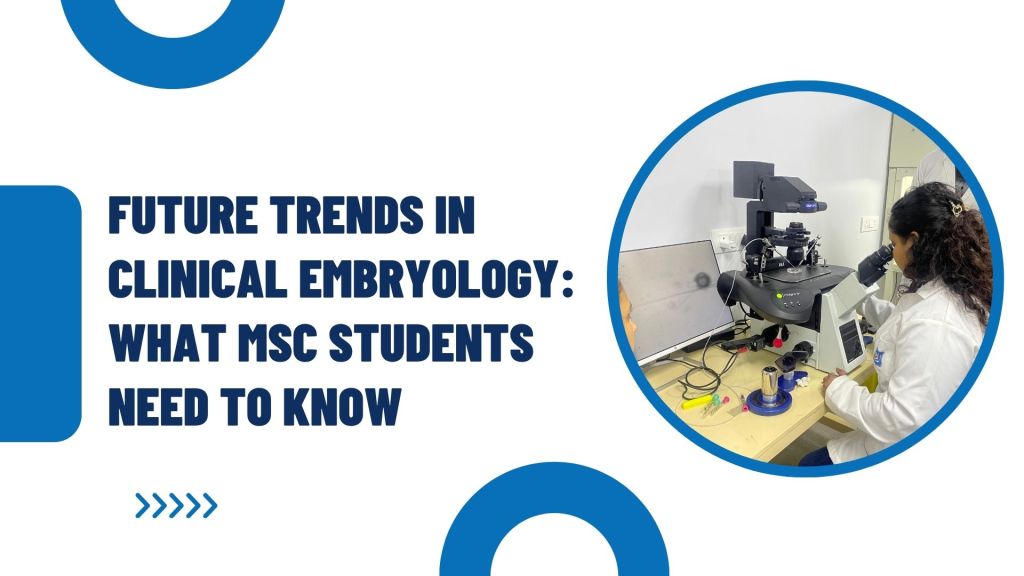
Clinical embryology is a fast-growing field that keeps changing with new science and technology. If you’re planning to study or are already doing an MSc in Clinical Embryology, you’re entering into a field with lots of future opportunities. In this blog, we’ll explain the latest trends in clinical embryology in easy words, so you can understand what’s coming next and why it matters.
1. Personalized Medicine: Treatments Made Just for You
One of the important changes in fertility treatment today is something called personalized medicine. This means doctors look at your own body and genes to find the best way to help you get pregnant. Instead of trying different treatments to see what works, they can choose the right one from the start. This makes the process faster, less stressful, and often more successful, saving you time, money, and worry.
2. Artificial Intelligence (AI) in Embryology
AI isn’t just for robots or smart devices—it’s also helping doctors in fertility labs. With the help of AI (Artificial Intelligence), scientists can look at pictures of embryos and pick the best ones to help someone get pregnant. These smart tools check images taken at different times and can tell which embryos have the best chance of growing into a healthy baby. This makes choosing embryos more accurate and fair, instead of depending only on what a person thinks. AI can also guess how well a treatment might work, which helps make fertility treatments better and more trusted.
3. Non-Invasive Testing: Safe and Gentle for Embryos
Before, to check if an embryo had any genetic problems, doctors had to take a tiny piece out of it. This was called a biopsy. But now, there’s a safer and easier way. Embryos naturally release some DNA into the liquid they grow in, and doctors can now test that liquid without touching the embryo. This new method is called non-invasive preimplantation genetic testing. It doesn’t harm the embryo and is less stressful for parents. It’s a big step in making fertility treatments safer, gentler, and more advanced.
4. Better Cryopreservation: Freezing Eggs and Embryos
Cryopreservation means freezing eggs or embryos so they can be used later. This technique has become much better over time. A new method called vitrification helps keep eggs and embryos safe and healthy when they are frozen and then used later. This is very helpful for people who want to have children later in life or need to protect their fertility before treatments like chemotherapy. Scientists are also working on freezing ovarian tissue, which could help even more people in the future.
5. Genetic Editing: The Promise and the Questions
Scientists are now looking at ways to fix genetic problems before a baby is even born. They are using new tools like CRISPR-Cas9, which can change or repair faulty genes in embryos. This could help stop some inherited diseases from being passed on. While this sounds like a big step forward, it also brings up important questions. Is it safe to change genes in an embryo? What could happen in the future? These are things scientists, doctors, and society need to think about carefully and decide together.
6. Microfluidics and “Lab on a Chip” Technology
Imagine doing many lab tasks on a small chip! Microfluidics is a new technology that can make IVF (in vitro fertilization) faster and easier. With this, things like choosing the best sperm, preparing eggs, and growing embryos can all happen automatically on a tiny device. This can save time and reduce mistakes made by humans in the lab.
7. Polygenic Risk Scoring: Looking at the Big Genetic Picture
New tests can now check many genes at the same time to see if an embryo might have a higher chance of getting diseases like diabetes or heart problems later in life. This is called polygenic risk scoring. While this can help pick healthier embryos, it also raises important questions about whether it’s right to choose embryos based on traits, not just health.
8. Regenerative Medicine and Stem Cells
Scientists are studying stem cells and new medicines to help treat infertility. In the future, they might be able to make eggs or sperm from a person’s cells. This could help people who can’t produce their eggs or sperm and could make a big difference for many struggling to have a baby.
9. Ethical and Social Considerations
With all these new technologies, ethical questions are more important than ever. For example:
- Is it right to edit the genes of an embryo?
- Should we select embryos based on their risk for future diseases, or even for traits like height or intelligence?
- How do we make sure these technologies are available to everyone, not just a few?
As a clinical embryologist, you will need to think about these questions and help patients understand their choices.
10. What Does This Mean for MSc Students?
If you are studying or planning to study for an MSc in Clinical Embryology, here’s what these trends mean for you:
- Stay Curious and Keep Learning: Discoveries happen all the time. Be ready to learn about new technology and ideas throughout your career.
- Get Comfortable with Technology: AI, genetic testing, and lab automation will be part of your daily work. Learning how to use these tools will make you a better embryologist.
- Understand Ethics: You will need to talk with patients about their options and help them make informed choices. Understanding the ethical side of your work is just as important as the science.
- Research Skills Matter: Many MSc programs include research projects. These help you learn how to ask questions, design experiments, and analyze data—skills that are valuable in any job, whether in the clinic, lab, or industry.
- Communication is Key: You will work with doctors, nurses, and patients from all walks of life. Being able to explain complex ideas in simple words is a big advantage.
Conclusion
The future of clinical embryology has many changes ahead. New tools like personalized medicine, AI, non-invasive testing, and gene editing are helping fertility treatments work better and reach more people. But these changes also bring questions about what is right and fair. As an MSc student, you will be part of these changes, helping families, learning new things, and building the future of reproductive medicine. If you are interesed then as per my experience SEART(School of Embryology and Assisted Reproductive Technology)

